
January 28, 2026
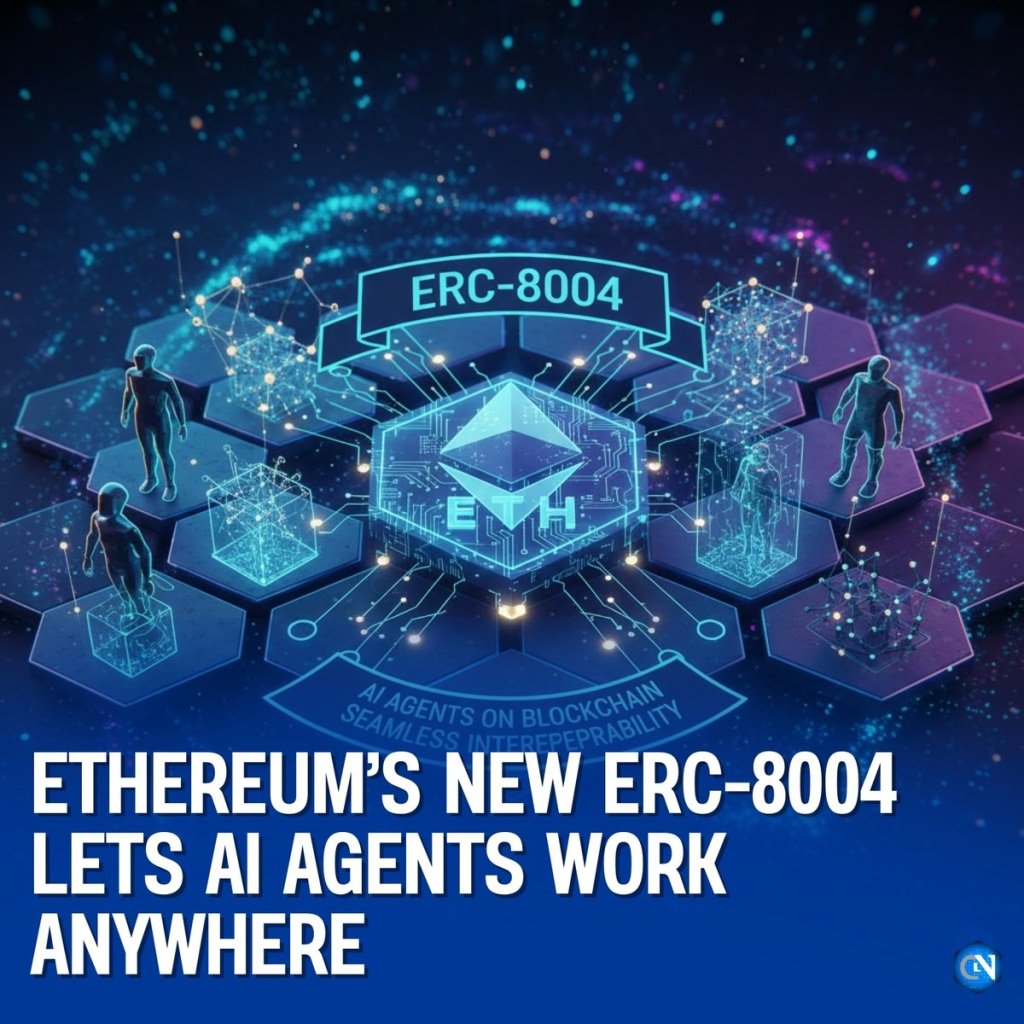
Yesterday, Ethereum rolled out ERC-8004 (https://eips.ethereum.org/EIPS/eip-8004) to mainnet—a new standard that gives AI agents persistent on-chain identities and portable reputations. My first reaction, like many building in the AI infrastructure space, was to ask: does this compete with what we’re building at Nodalync ?
After digging into the spec, my answer is no. In fact, it’s the opposite. ERC-8004 makes the agentic economy more real and more interoperable, which increases demand for what Nodalync provides.
Let me explain.
What ERC-8004 Actually Does
For those unfamiliar with Ethereum Improvement Proposals, ERCs are standards that allow different applications to work together on Ethereum’s blockchain. ERC-20 standardized tokens. ERC-721 made NFTs possible. Now ERC-8004 is attempting something equally foundational: a shared infrastructure for AI agent trust.
The standard introduces three lightweight registries:
Identity Registry — Every AI agent gets a unique, portable identifier stored as an NFT. This means an agent’s identity isn’t locked to OpenAI or Google or Anthropic—it exists on-chain and can move between systems.
Reputation Registry — A structured way to record feedback about agent performance. Think Uber ratings, but permanent and verifiable on Ethereum.
Validation Registry — Hooks for independent verification of agent work through cryptographic proofs, trusted execution environments, or stake-secured validators.
The team behind it includes engineers from MetaMask, Google, Coinbase, and the Ethereum Foundation. They’ve explicitly designed it as neutral infrastructure rather than a marketplace. Payments, pricing, and business models are intentionally out of scope.
That last part is important.
The Trust Problem in Agentic AI
To understand why ERC-8004 matters, you need to understand the problem it solves.
Right now, AI agents operate in silos. Claude can’t verify that a GPT-based agent is legitimate. An autonomous trading bot can’t assess whether an analysis service is trustworthy. Every interaction between AI systems from different organizations requires pre-existing relationships or blind faith.
This works fine when humans are in the loop making every decision. It breaks completely when agents need to act autonomously—hiring other agents, executing transactions, collaborating on tasks without human supervision.
ERC-8004 addresses this by asking: Can I trust this agent?
It gives every agent a verifiable identity. It lets agents build reputations over time. It provides mechanisms to validate that an agent actually did what it claims.
But notice what it doesn’t ask: Where did this agent’s knowledge come from? Who contributed to it? How should value be distributed when that knowledge creates value?
That’s a different problem entirely.
Roads and Libraries
Here’s the analogy I keep coming back to: ERC-8004 is building roads. Nodalync is building libraries.
Roads are essential infrastructure. They let vehicles move between locations, establish rules for traffic, create a shared system everyone can use. Without roads, commerce stalls. Communities stay isolated. The economy fragments.
ERC-8004 is doing exactly this for the agentic economy. It’s creating the infrastructure that lets AI agents discover each other, establish credibility, and interact across organizational boundaries. It’s the transportation layer.
But roads don’t create the goods being transported. They don’t determine who gets paid when those goods reach their destination. They don’t track the supply chain that produced them.
Libraries do something different. They organize knowledge. They track attribution. They ensure that when information is accessed and built upon, the chain of contribution remains visible.
Nodalync is building the library for the agentic economy—a protocol where knowledge has cryptographic provenance, where every query triggers payment through the entire derivation chain, and where foundational contributors get compensated automatically when their work creates downstream value.
These aren’t competing functions. They’re complementary layers of the same stack.
What Nodalync Does Differently
Let me be concrete about the gap that exists even with ERC-8004 in place.
Say an AI agent uses ERC-8004 to verify that a knowledge provider is legitimate. Great—it now knows it’s dealing with a trustworthy source. But when that agent queries for information:
- How does it know where that information originally came from?
- If the knowledge was synthesized from multiple sources, who contributed what?
- When the agent pays for access, how is that payment distributed fairly?
The x402 protocol, which many are pairing with ERC-8004, handles basic HTTP payments. An agent can pay for a request and receive a response. But x402 is a payment primitive—it has no concept of provenance chains, root contributors, or synthesis fees. It’s “pay for this request,” not “compensate everyone whose work made this response possible.”
Nodalync solves this with a different architecture:
Cryptographic Provenance — Every piece of content has a verifiable chain showing what it derives from. When you query an insight (what we call L3), the protocol knows exactly which foundational sources (L0/L1) contributed to it.
Automatic Distribution — Payment isn’t just “agent pays provider.” It’s “agent pays provider, provider’s share flows to all upstream contributors automatically.” The protocol enforces a 95/5 split—5% synthesis fee to the content owner, 95% distributed to root contributors based on their provenance weight.
Knowledge-Specific Structure — We’ve built a layered system designed for how knowledge actually works: raw documents (L0), extracted atomic facts (L1), personal knowledge graphs (L2), and synthesized insights (L3). This isn’t generic data storage. It’s infrastructure specifically for the knowledge economy.
Settlement Efficiency — Micropayments for knowledge queries need to be cheap enough to be practical. We batch settlements and use Hedera’s sub-penny transaction costs to make this economically viable.
The Emerging Stack
I think the agentic AI landscape is going to standardize around a few complementary layers:
Communication Protocols — Google’s A2A and Anthropic’s MCP are establishing how agents talk to each other. These handle the mechanics of requests, responses, and tool invocation.
Trust Infrastructure — ERC-8004 is positioning itself here. Identity, reputation, and validation for autonomous agents operating across organizational boundaries.
Payment Rails — x402 and similar protocols handle the money movement. Instant, programmatic transfers when agents transact.
Knowledge Infrastructure — This is where Nodalync fits. Not just storing information, but tracking its provenance, ensuring fair compensation, and making the entire knowledge supply chain transparent and trustworthy.
None of these layers compete with each other. They stack. An agent might use MCP to communicate, ERC-8004 for identity, x402 for payment mechanics, and Nodalync for knowledge provenance and creator compensation.
Why This Matters Now
The timing of ERC-8004’s mainnet launch isn’t coincidental. We’re at an inflection point where AI agents are moving from experimental toys to actual economic participants.
Coinbase’s x402 protocol saw transaction volume increase by over 10,000% in October 2025. Cloudflare is championing machine-to-machine payments as a core web standard. The infrastructure for autonomous AI commerce is being built right now.
But infrastructure for AI identity and trust doesn’t automatically create infrastructure for fair knowledge economics. If anything, it makes the gap more visible. The more agents interact, the more they need reliable knowledge sources. The more knowledge gets queried and synthesized, the more important it becomes to track provenance and compensate contributors.
ERC-8004 makes the roads. Someone still needs to build the libraries.
What We’re Building
Nodalync is still early. We’re running on Hedera testnet, proving out the economics before scaling to production. The MCP server lets Claude and other AI assistants query knowledge through the protocol today. The core provenance chain and settlement mechanics work.
What’s next is integration with the broader agentic ecosystem—potentially including ERC-8004 agent identities for Nodalync nodes. If an agent’s reputation on Ethereum becomes a signal for content quality, that’s useful information. If Nodalync’s provenance tracking can inform reputation scores, that’s useful too.
The agentic economy needs both roads and libraries. I’m building the libraries.
If you’re working on adjacent infrastructure—agent identity, machine payments, knowledge systems—I’d love to talk. The stack is still being defined. Now’s the time to get it right.
About the author
Gabriel Giangi is the creator of the Nodalync Protocol, a decentralized system for knowledge exchange with cryptographic provenance and automatic creator compensation.
 Gabriel Giangi
Leave a comment