
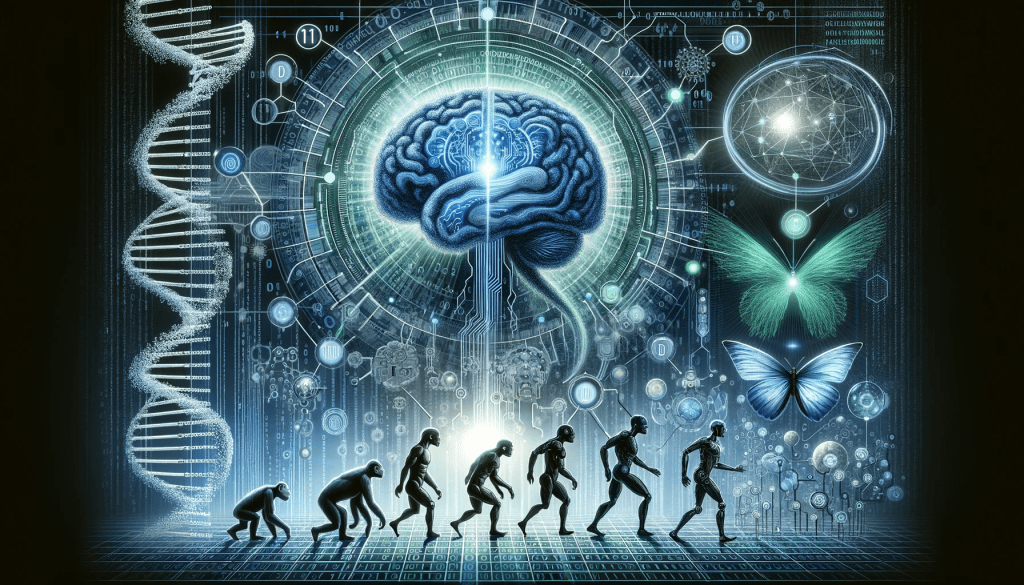
In our pursuit of Artificial General Intelligence (AGI), a paradigm as intricate as human intelligence, we often find ourselves sidestepping the elemental foundations of life, seeking immediate complexity. This perspective, however, disregards the profound significance of evolutionary processes that have led to the marvel of human cognition. The prevailing methodologies, dominated by grand-scale server architectures orchestrating massive language models, albeit impressive, tend to exhibit an anthropomorphic bias. They focus on tasks that align with our current understanding, overlooking the eons of gradual refinement and adaptation that have sculpted our cognitive landscape.
A significant drawback of current AGI approaches is their limited engagement with the real world, a trait that distinguishes all living beings. When we confine an intelligent agent solely to digital interfaces or descriptions in words, we fall short in capturing the rich subtleties of genuine experiences and interactions. It’s intriguing how our attempts to depict the world using our own vocabulary and interpretations reveal their limitations. Although we can share our experiences with others, the true essence of these experiences remains elusive to those who haven’t lived them firsthand. Our languages, formed by diverse societies, are undeniably impressive, yet they merely provide basic outlines of the intricate tapestry of our surroundings.
This is where the perplexity arises when some argue that large language models hold the key to AGI. Essentially, we input our vocabulary—an abstraction of our experiences—into these models, optimistically believing that copious amounts of data will enable AI to understand the world effectively. However, what’s often overlooked is that the words generated lack genuine experiences or meanings; they are essentially products of probability computations. While these techniques showcase commendable abilities, they lack a clear trajectory towards achieving true AGI. Instead, they unintentionally gravitate towards a brute-force imitation of intelligence.
The point of focus should be that all intelligent organisms share the trait of survivability. The process of biological evolution is driven by survival, The complex living organisms we observe today are the result of succession of evolutionary traits. We put a lot of emphasis on the intelligence of humans, however, if you look at it objectively, we are not that far from the rest of biological life. Many of our actions, thoughts, and feelings stem from our evolutionary experiences of survival. Apes, our closest known biological ancestor, share almost all the traits that humans do, including their own means of communication. They have evolved to have better physical characteristics to maintain their survival, while our evolution has geared more so on intellectual development. Regardless, the point is that for a being to be biologically intelligent, it must have learned how to survive well. Therefore, intelligence should be quantified as the entity’s capability to adapt and evolve to environmental stimuli in the pursuit of survival.
We are not gods, and to think that our current state of intelligence is the epitome of intelligence is just wrong. There is a real possibility that the true future of AGI resembles nothing like humans, as we potentially can engineer an evolutionary race that do not have the same limitations that biological life forms have. True AGI may not require the means to reproduce to survive and may have the benefit to evolve to learn how to modify and adapt physical constraints in the pursuit of survival.
In summary, I believe our research endeavours should center on the notions of evolution and adaptation, particularly when framing our understanding of intelligence and shaping our vision of AGI. Could we be on the brink of an era characterized by artificially intelligent cells, capable of evolving at a pace that outstrips any biological entity? Is it plausible that true AGI might manifest as a technological biosphere, transcending the capacities of a solitary organism and ushering in an era of unparalleled research opportunities? These questions remain unanswered in my current exploration, but I am firmly convinced that authentic AGI will not be constrained by anthropomorphic tendencies. Rather, it could encompass intelligent entities coexisting with our species, collectively propelling civilization forward.
 Gabriel Giangi
Leave a comment